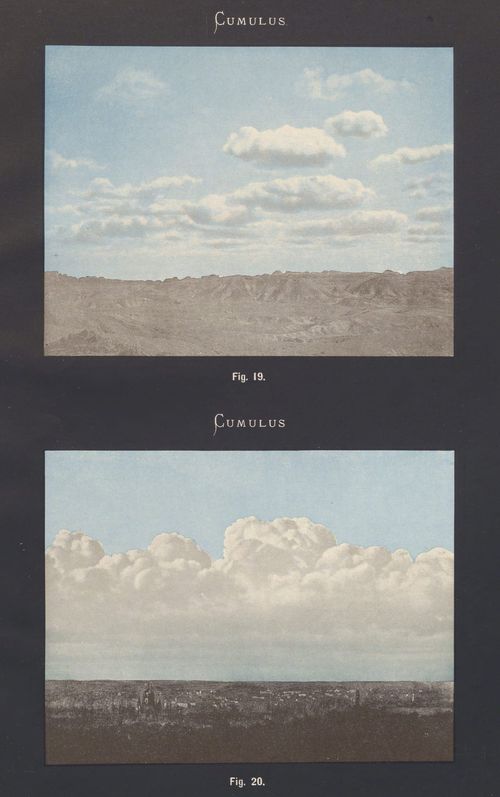
There is urgently needed a classification of clouds which will tell of the origin of the cloud and its life history. When we look at a cloud we want to know, not what it resembles, but whether it portends fair or foul weather. It should be an index of the flow of air and the behavior of the water vapor. It must be admitted that present names do not help us much, and we are left in ignorance of that which we should most like to know, namely, the significance of cloud life in connection with impending weather.
—A Cloud Atlas, by Alexander McAdie
Catching up with a former colleague a week ago, I mentioned something about doing more writing and research about the AT Protocol/Atmosphere, and he said “Is that happening?” “—the Atmosphere?” I said. “Yeah,” he said, “it seems like it’s happening!”
It’s happening. But although it’s happening in what is technically “the open”—people are making new projects and doing increasingly weird and cool things—this fizzy explosion of projects is not really visible or legible to a lot of people who aren’t actively following protocol stuff. And “protocol stuff,” for various reasons, still reads to a lot of people as a distraction from the “real” thing, which is a 1:1 replacement for Twitter but with progressive-coded moderation. I think that analysis is completely understandable and also wrong, for a string of reasons: Lock-in is a permanent vulnerability while “good” centralized governance by any given company is ephemeral and situational, no matter how well it begins. High-context moderation, alas, doesn’t scale. And there’s much more to sociability online than microblogging—and all of it needs better infrastructure and better tools. Some of which decentralized ecosystems are already providing!
But saying that only goes so far, and under-contextualized demos aren’t much better, because you have to care enough to watch them in the first place. I think it’s time to start building a very contextual map of the apps, systems, people, and ideas bubbling up across the protocol. There are hundreds of projects underway, though. App directories are great things to have, but again, you have to care enough to go looking. So how to begin?
My answer for most knowledge gaps is “talk to people,” so that’s what I’m doing. I’m spending a few weeks sorting out what questions need asking and then doing interviews with people across a dozen-odd Atmospheric projects. And later this fall, I’ll publish the results using probably several different Atmospheric apps. You can read the (quite brief) project brief at atmosphere.community, but the shortest version is that my aim is to produce a guide—visual and written—of immediate use to folks who’d like to do things on the internet without being stuck in maximally corrupt systems, but who aren’t plugged into at-proto stuff enough to know or care about any given project purely because of its use of the protocol.‡
I’ve done hundreds (thousands?) of interviews in the course of my career, and I know how to learn interesting things. But the right questions to arrive with—and the right structure for what comes out of the interviews—are not completely obvious. So I’ve been spending some time thinking about clouds.
The forms of clouds

I’ve been looking at a lot of cloud atlases as our local forecasts become less accurate and I try to get better at understanding the marine-zone weather we live with. Cartographic atlases like the road atlases some of us grew up with are collections of maps, but scientific atlases are something more like visual collections of standards: In the eighteenth and nineteenth centuries, anatomical atlases gave physicians a shared reference for the inward and normally invisible world of the human body. We got atlases of solar spectra, of skin disease, and of…everything.
But cloud atlases are the best. They collect detailed pictures of distinct cloud types and usually accompany them with instructions for precise observation. The first cloud atlases in the 1890s turned the then-newly defined taxonomy of cloud types into a visual reference people could use, anywhere in the world, to understand what they were looking at when they looked up.
Making the atlases was startlingly difficult and required a lot of foundational study and decision-making beforehand, because standards are hard. The idea that something as shifting and ephemeral as cloud forms could be divided into uniform universal and official types was relatively new, despite the obvious presence of local and oral weather-knowledge. As Stanley David Gedzelman put it in an absolute banger of an article in the Bulletin of the American Meteorological Society, “knowledge and understanding of clouds prior to 1800 remained uncoordinated, haphazard, and absent from the written record.” I feel this in my bones.
Lamarck (yep, that one) produced a typology of clouds in French in 1801, a year before Luke Howard, a Quaker chemist in England, did the same, but in Latin.† Howard’s classifications caught on and are the basis of our current cloud typology, first gathering attention in the weird little pool of budding meteorologists and then ten years later via Thomas Forster’s Researches About Atmospheric Phaenomena, which turned the painters Constable and Turner onto them, and then Goethe discovered Howard’s classifications and wrote (I am sorry) a series of fan-poems about them.
Before getting into atlas assembly, the Hon. Ralph Abercromby sailed around the world, twice, to determine that yes, clouds seemed to display the same forms everywhere on Earth, because I guess we didn’t know that until then. The cloud-spotters behind the early atlases were also extremely interested in developing a more objective method of illustration than the one offered by the long tradition of cloud painting, and one crucial guy, Hugo Hildebrand Hildebrandsson, spent years in the 1870s doing beautiful, expensive, and incredibly difficult cloud photography around Uppsala, Sweden, to show that it could be done.
Hildebrandsson’s first Cloud Atlas, published in 1890, combined small reproductions of 12 black-and-white photos with large full-color reproductions of paintings. This first attempt was good enough to lead, eventually, to the International Meteorological Committee’s International Cloud-Atlas of 1896, which was printed in French, German, and English and featured astonishing color images produced using early (and very expensive) color photography techniques, along with a few paintings of particularly photo-elusive clouds. The International Cloud Atlas is still very much alive, and is now online on a reassuringly ugly website—and has clearly remained subject to as much brangling as any other set of international standards.
What counts as knowledge
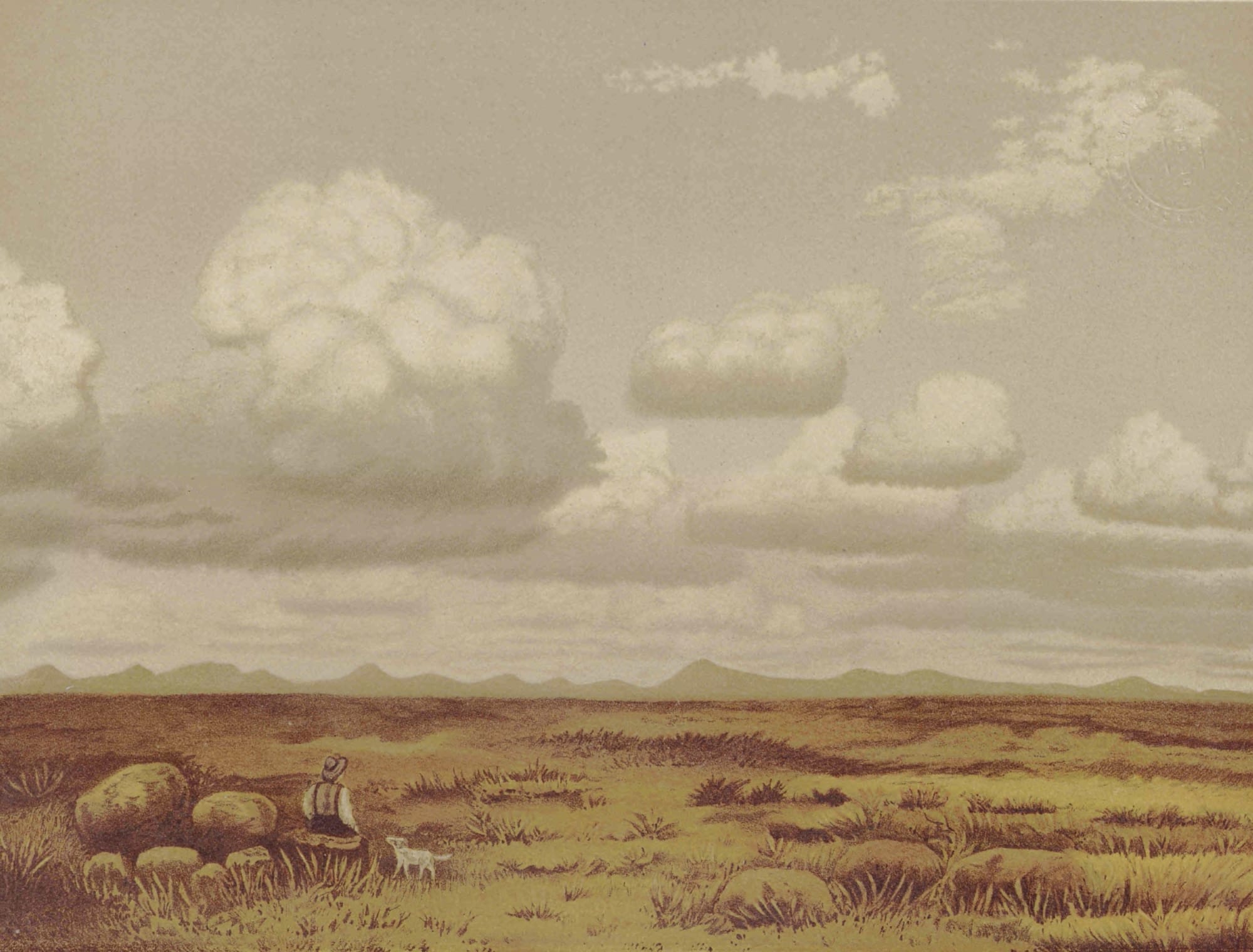
What's missing in the formation of “objective” standards are the things left out in any reductive standards-setting process. The atlases omitted local and traditional knowledge about clouds and the way they move and change and produce omens and signs as well as weather: hyperlocal observation, ethnometeorology, traditional navigation, chorography, deep maps. And, separately, as McAdie complains in the quote at the top of the post, a typology of stills alone doesn’t give us what we most need, which is direction and relevance, even if we can’t reasonably hope for prediction. The cloud atlas doesn’t have to be the cloud territory! But there are things to learn from the atlases’ omissions, and to improve on.
The human texture and qualitative specificity of projects in the Atmosphere are as interesting to me as any set of technical and design specifications could possibly be. Interesting for their own sake, and also for the ways they’re shaping each project’s current state and its likely futures. I also believe in just getting out there and gathering foundational knowledge. There's value in offering classification systems even when they're provisional and even when they’re only one among many. I read a lot of oral histories and interviews and human-textured research from older social movements and periods in technology that inflects my understanding of the world now—the ACT UP oral history project that kept me sane in during the Covid Tracking project, the very human testimonies of the Combahee River Collective, even the (delightful) work that came out of the early stumbles of the Worm Community System. I like to think that if things go even halfway well, the work we’re all doing to make new online social systems legible will help in the present and be a useful ship’s log for the people who come after us. Understanding what we’re trying do—and why—will matter later, is the bet.
So: “A Cloud Atlas,” rather than just “Cloud Atlas.” An attempt and an experiment, with an eye and an ear to the vernacular and the ordinary. A place to begin.
Thanks & notes
This project is possible because of the support of the AT Community Fund and the folks who are members at wreckage/salvage. Special gratitude to Boris, Nick, and Ted at the Community Fund for giving the project a home and a seed toward funding, and to Bluesky, Cosmik, and Blacksky Algorithms for their early and enthusiastic support. If you or your project or organization would like to back the work, it’s at Open Collective.
Notes
† Lamarck’s names didn’t catch on, maybe because they were less suited to the scientific mood of the moment (they included pommelés or dappled clouds and en forme de voile or veil-form clouds) and maybe because Napoleon was such a dick.
‡ Longtime readers may remember that I tried to work on a similar project a couple of years ago, coming out of my work on fediverse governance: I started a series of interviews focused on helping newcomers to decentralized networks find welcoming fediverse servers. Had things gone differently in US electoral politics, that work would have been live for more than a year now. What I found instead was that the majority of Fediverse server teams I approached—even the ones in Europe—were exhausted, hunkering down, or closing up shop in the immediate aftermath of the presidential election, and needed all their time and focus to maintain the stability they had. In recognition of their collective trouble, I shelved the project a couple of interviews in, and shortly thereafter helped found Unbreaking to work directly on tracking the damage in the US. It may yet rise again; we’ll see how things go.