I gave a new talk at the end of March for the network-makers at Atmosphere Conf in Vancouver, BC. It started with a very compressed version of the arguments I made in Landslide; A Ghost Story and continued into a fly-through of some (kelp-centric!) ideas about remediating and reviving various parts of our networked information ecosystem, all tuned for an audience of developers and thinkers working on, in, and around the AT Protocol—the one that underlies Bluesky, the community-led multifaceted networks at Blacksky, Northsky, Eurosky, and Gander, spooky moth-inspired Anisota, vibey blog platform Leaflet, social citation/knowledge collider Semble, news extractor Sill, social annotator Margin, website-assembler Blento, social coding zone Tangled, and many (many) other things.
In the talk, I covered an honestly unwieldy number of interventions and design dreams for people interested in rebuilding our information ecosystems—because again, a talk for active builders, which is maybe my favorite kind of talk to give. But more than anything else, it was about treating ordinary people as subjects with agency, not objects to be manipulated. (“Networks as if people matter,” maybe.)
I’m not going to publish an essay version of the talk, though. For one thing, this isn’t its final form, and if the stars align, I’ll deliver a different one for a broader audience this summer. For another, there are just too many things in thar, so I’m going to let this post stand as a record of the talk at the time and build things out from there.
Communion in community
The conference was really good, in a way that I’m not sure any other purely tech conference I’ve ever attended has been good—a little conclave of active, curious, friendly builders who don’t want to pretend that things are fine, that the technical isn’t political, or that the money will work itself out if we just do the same thing all over again. It was refreshing in a way I didn’t expect at all. It was so heartening. (A bunch of people also got covid, which I hate. If you were one of them, I’m so sorry you got sick.)
Thank you so much to Boris, Nick, and Ted for inviting me to speak and covering my travel so I could come up. Thank you also to the people who support me here. I couldn’t have done the reading and thinking that went into the talk—or the work I do at Unbreaking—without the help of people who have put actual cash toward the work I do. (If that isn’t yet you, and you’d like to see more of what I do here, you can throw in with me here or send a one-time gift. I don’t have a huge membership, but it really does buy groceries, which means that I can keep doing both Unbreaking and this work out on the shorelines of our weird new networks.)
Many videos, some surrounded by small frogs
A video of the talk exists as a data object in the atmosphere, along with videos of almost all the other talks. You can watch on the conference site itself, or on Blaine Cook’s astonishing ionosphere.tv (maybe not in Safari but oh my god look at this conceptual index of the conference), or with Business Goose’s high-viridian vod frog, which includes frog-shaped cursors. All of which are made possible because stream.place put all the conference video into the protocol and the community pounced on it.
Or you can watch it on YouTube but that feels kind of stubby and boring now.
Slides & image notes
And here are my slides, mostly so you can see the image credits.
And if you just want to see the beautiful images, here you go:
- Anna Atkins’ work is a real balm for the soul; I come back to her cyanotypes when I need to fine-tune my brain. The one I used is one of her dictyota dichotoma images, from the NYPL collections; the Met has a lot of great images as well, as does the Getty.
- The Anchorage earthquake photo and the Valdez landslide drawing (p. C-11) are both courtesy of the USGS; USGS credited the drawing to David Laneville of the Alaska Department of Highways. Thank you, David.
- The beautiful kelp photos I used are from Ben Wicks (Laminaria digitata) and Erick Morales Oyola (Catalina kelp forest), both on Unsplash.
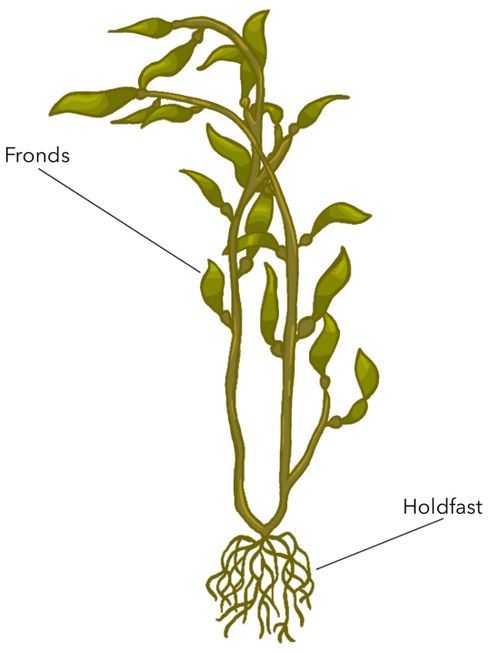
- My daughter Juna drew and colored the original kelp illustration in the slides (and in this post) in Procreate. Thank you, best child. And thank you, conference folks, for being so cool that my kid went back to middle school with your stickers on her water bottle and folders. There’s hope.
About the machines
The last thing I want to note here before I list citations is that I speak about “AI” (LLMs, or, as we call them at home, “generators”) several times and in several ways in the talk.
It’s a weird time. I share my friends and colleagues’ concerns, worries, and revulsions about the damage these systems produce, both at their points of origin and their many misuses. And also, we’re past the point when “they don’t do anything useful for anyone ever” is true. Much of my role is to look and listen carefully and then explain what I’m seeing and hearing, and that includes the observation that there are non-devs (and non full-time devs) building extremely interesting and helpful tooling for their communities who would not be able to do that work without LLM assistance. Which I know that because I’ve seen the work, and I’ve listened to them.
If you don’t hang out with software people, or you only hang out with the ones who scrupulously avoid these systems, this may still be invisible to you, but things have changed very quickly in software development specifically. I think that when people find the generators professionally useful, they’re going to use them unless something makes them too expensive to afford, so we should try to understand how that’s going to play out.
Citations
Amsalem, Eran, and Alon Zoizner. “Do People Learn about Politics on Social Media? A Meta-Analysis of 76 Studies.” Journal of Communication 73, no. 1 (2023): 3–13. https://doi.org/10.1093/joc/jqac034.
Cao, Zike, Yingpeng Zhu, Gen Li, and Liangfei Qiu. “Consequences of Information Feed Integration on User Engagement and Contribution: A Natural Experiment in an Online Knowledge-Sharing Community.” Information Systems Research 35, no. 3 (2024): 1114–36. https://doi.org/10.1287/isre.2022.0043.
Epstein, Ziv, Nathaniel Sirlin, Antonio Arechar, Gordon Pennycook, and David Rand. “The Social Media Context Interferes with Truth Discernment.” Science Advances 9, no. 9 (2023): eabo6169. https://doi.org/10.1126/sciadv.abo6169.
Frauhammer, Luna T., and Jana H. Dreston. “How Cognitive Elaboration Fosters Knowledge Acquisition on Social Media—a Field Experiment.” Journal of Computer-Mediated Communication 30, no. 5 (2025): zmaf014. https://doi.org/10.1093/jcmc/zmaf014.
Green, Melanie C., and Timothy C. Brock. “The Role of Transportation in the Persuasiveness of Public Narratives.” Journal of Personality and Social Psychology 79, no. 5 (2000): 701–21. https://doi.org/10.1037/0022-3514.79.5.701.
Jahn, Laura, Rasmus K. Rendsvig, Alessandro Flammini, Filippo Menczer, and Vincent F. Hendricks. “A Perspective on Friction Interventions to Curb the Spread of Misinformation.” Npj Complexity 2, no. 1 (2025): 31. https://doi.org/10.1038/s44260-025-00051-1.
Karpicke, Jeffrey D., and Janell R. Blunt. “Retrieval Practice Produces More Learning than Elaborative Studying with Concept Mapping.” Science 331, no. 6018 (2011): 772–75. https://doi.org/10.1126/science.1199327.
Mede, Niels G., Adrian Rauchfleisch, Julia Metag, and Mike S. Schäfer. “The Interplay of Knowledge Overestimation, Social Media Use, and Populist Ideas: Cross-Sectional and Experimental Evidence From Germany and Taiwan.” Communication Research, February 10, 2024, 00936502241230203. https://doi.org/10.1177/00936502241230203.
Meyrowitz, Joshua. No Sense of Place: The Impact of Electronic Media on Social Behavior. 1. issued as an Oxford Univ. Press paperback. Oxford Univ. Press, 1986.
Pearson, George. “Sources on Social Media: Information Context Collapse and Volume of Content as Predictors of Source Blindness.” New Media & Society 23, no. 5 (2021): 1181–99. https://doi.org/10.1177/1461444820910505.
Pittman, Matthew, and Eric Haley. “Cognitive Load and Social Media Advertising.” Journal of Interactive Advertising 23, no. 1 (2023): 33–54. https://doi.org/10.1080/15252019.2022.2144780.
Rozenblit, Leonid, and Frank Keil. “The Misunderstood Limits of Folk Science: An Illusion of Explanatory Depth.” Cognitive Science 26, no. 5 (2002): 521–62. https://doi.org/10.1207/s15516709cog2605_1.
Sanders, Robert. “Pacific Kelp Forests Are Far Older than We Thought.” Berkeley News, January 15, 2024. https://news.berkeley.edu/2024/01/15/pacific-kelp-forests-are-far-older-than-we-thought/.
Schäfer, Svenja. “Illusion of Knowledge through Facebook News? Effects of Snack News in a News Feed on Perceived Knowledge, Attitude Strength, and Willingness for Discussions.” Computers in Human Behavior 103 (February 2020): 1–12. https://doi.org/10.1016/j.chb.2019.08.031.
Sundar, S. Shyam, Eugene Cho Snyder, Mengqi Liao, Junjun Yin, Jinping Wang, and Guangqing Chi. “Sharing without Clicking on News in Social Media.” Nature Human Behaviour 9, no. 1 (2025): 156–68. https://doi.org/10.1038/s41562-024-02067-4.
Van Aelst, Peter, Patrick Van Erkel, Laia Castro, et al. “The Limits of Social Media as a Source of Political Information during Routine and Crisis Times across 17 Countries.” Journal of Information Technology & Politics, May 17, 2025, 1–17. https://doi.org/10.1080/19331681.2025.2501033.
Van Erkel, Patrick F. A., and Peter Van Aelst. “Why Don’t We Learn from Social Media? Studying Effects of and Mechanisms behind Social Media News Use on General Surveillance Political Knowledge.” Political Communication 38, no. 4 (2021): 407–25. https://doi.org/10.1080/10584609.2020.1784328.
Yamamoto, Masahiro, and Fan Yang. “Does News Help Us Become Knowledgeable or Think We Are Knowledgeable? Examining a Linkage of Traditional and Social Media Use with Political Knowledge.” Journal of Information Technology & Politics 19, no. 3 (2022): 269–83. https://doi.org/10.1080/19331681.2021.1969611.